(This is a working draft that I will update from time to time.)
I recently read the Scientific American article “No One Can Explain Why Planes Stay In The Air.” I’ve always wanted to write a book on this topic, but this article has prompted my unified explanation for lift below.
Relative Pressures
Relative pressures seeking equilibrium are what move an object in one direction or the other. Hold a sheet of paper in a room and it does not move because the atmospheric pressure is acting equally on all sides. Take that same sheet of paper and lower the pressure on only one side. The molecules on the opposing side of the paper will no longer have a counterforce resisting expansion and therefore the molecules will expand toward the path of least resistance. Consequently, the paper is pushed in a direction.
The same effect holds true if, instead of lowering the pressure on one side, the pressure is increased only on one side of the sheet of paper. The paper will move in the direction of the lowest relative pressure as the relatively higher pressure air (static pressure) expands or is moved by its momentum (dynamic pressure) toward equilibrium due to the absence of an equal counterforce.
Atmospheric Pressure
The air expands when there is a shift in equilibrium because the atmosphere is in a constant state of relative compression due to the force of gravity acting on the atmosphere. Incidentally, the atmospheric pressure is highest at the ground surface. The expansion potential of a given portion of the atmosphere can be observed by filling a balloon at any given atmospheric pressure, then subjecting that balloon to a vacuum chamber. As the vacuum chamber purges, the balloon will expand in the chamber due to the decrease of a counterforce.
Airfoils
Lift
Lift occurs when the difference between the higher Dynamic Pressure below the airfoil and the lower Static Pressure above the airfoil is large enough to overcome the force of gravity acting on an object.
Dynamic Pressure is the pressure created when a moving flow hits a surface and the flow compresses, or when a non-moving volume is hit by a surface that compresses the non-moving volume.
Static Pressure is the pressure created by either gravity acting on the atmosphere or when a fixed volume is pressurized by other means (e.g. a pressurized cylinder).
The Relative Pressures of an Airfoil
In other words, airfoils generate lift by maximizing the pressure difference between both sides of the airfoil. The lift force actually comes from the Dynamic Pressure of air molecules below the airfoil that both resist movement and compression from the surface acting upon it. By generating a vacuum on the distal curvature of the upper surface of the airfoil, the lift originating from the lower surface of the airfoil due to Dynamic Pressure is amplified because the Static Pressure counterforce on the upper surface of the airfoil is reduced.
How Flow Friction Generates an Airfoil Vacuum
The reason for the vacuum generation on the distal curvature of the upper surface of an airfoil is friction. The flow would normally move in a straight line, but the friction from the flow moving above an airfoil “grabs” the air molecules between the flow and the upper distal curvature of the airfoil. Since the non-permeable surface of the airfoil restricts the replenishment of the lost molecules from below, a vacuum is formed. The atmospheric static pressure then forces the flow downward toward equilibrium, which gives the appearance of the flow sticking to the surface of the airfoil.
Flow Separation
Flow Separation happens when friction from the flow is no longer generating a vacuum by means of “grabbing” the molecules between the flow and the upper distal curvature of an airfoil. When the attack angle of the airfoil reaches a certain threshold, a clockwise moving vortex forms in this region. A vortex is able to form because as the attack angle of the airfoil increases, the surface friction of the airfoil, in the direction opposite of the flow, becomes negligible. Therefore, the air molecules, which would otherwise be carried off through friction, instead start rotating like a wheel getting pushed by the flow and even grab molecules from the flow. As the rotational speed of the vortex matches the speed of the flow, the static pressure on the airfoil surface normalizes causing a significant drop in lift, also known as a stall.
Flow Separation. Source: https://en.wikipedia.org/wiki/Flow_separation. License: This image has been released under a free license by the Deutsches Zentrum für Luft- und Raumfahrt (DLR). Reference: DLR Imprint.
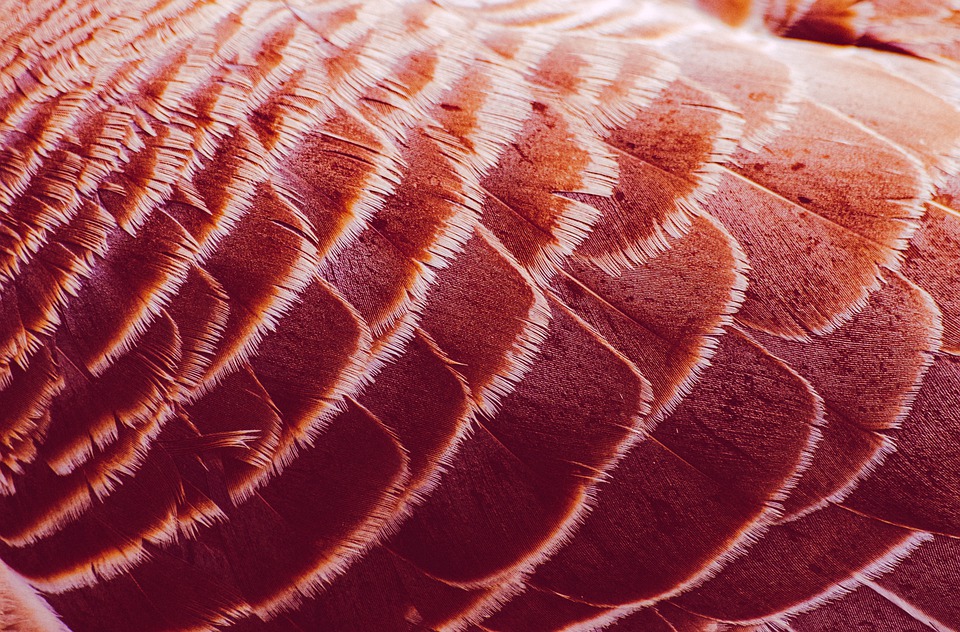
In nature, bird feathers likely act as a natural counter-vortex since they are layered in a way that allows the flow to easily move in one direction while trapping any vortex attempting to move clockwise in the opposite direction. Applying a similar layered structure to the distal curvature of the upper surface of an airfoil would likely inhibit flow separation through vortex formation and therefore enable higher airfoil efficiencies by further maximizing the pressure difference between the opposing surfaces of the airfoil.


 Mohyi Labs